
Khoa học & phát minh
A Nobel Prize for molecules that are mirror images
Henri Kagan and Kenso Soai won the 2026 Nobel Prize in Chemistry for showing how reactions can favor one mirror image.
On October 7, 2026, the Royal Swedish Academy of Sciences announced that the Nobel Prize in Chemistry 2026 would go to Henri B. Kagan of Université Paris-Sud, France, and Kenso Soai of Tokyo University of Science, Japan. The two chemists were honored “for the discovery of non-linear effects and autocatalysis in asymmetric organic synthesis.” In simple terms, they discovered how chemical reactions can favor one of two mirror-image molecules.
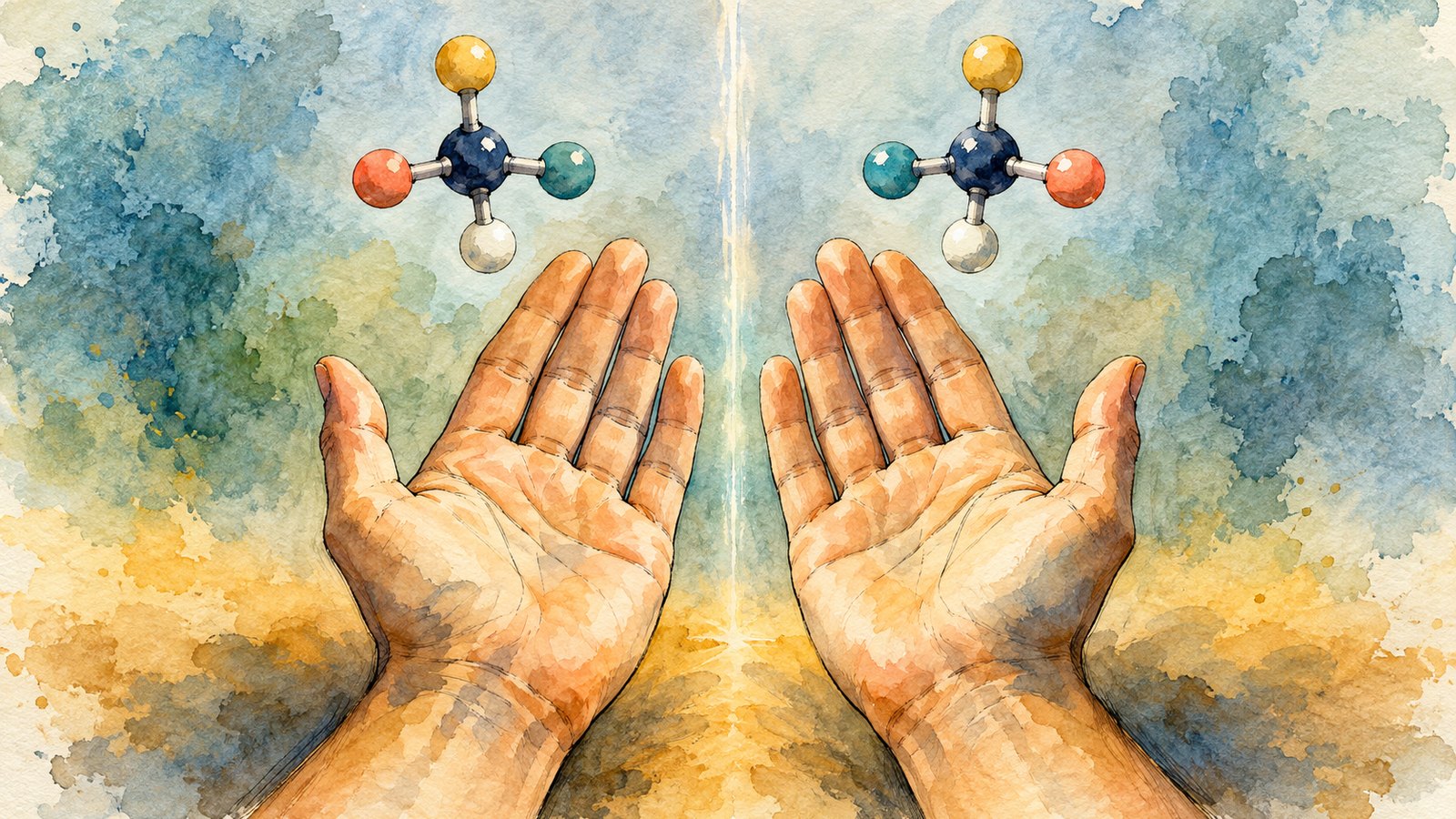
Your left and right hands are mirror images of each other: they look alike, but they are not identical. Some molecules, too, come in two mirror-image forms, and chemists call them chiral. Amino acids, the building blocks of proteins, are a good example. Our cells build proteins from just one form of each amino acid, and the mirror form is rare in the natural world. The same is true of the sugars in DNA: life uses only one of their two forms. Chemists call this one-handedness homochirality, from the Greek words for “same” and “hand.”
Từ vựng trong bài
Chiral (bất đối): chỉ một phân tử hay vật không trùng khít với ảnh gương của chính nó, giống như bàn tay trái và bàn tay phải.
Some molecules, too, come in two mirror-image forms, and chemists call them chiral.